
The Colomba d’Oro guide to Lessinia

When thinking of a trip to Verona, the first thought almost always goes to the historic center of the City of the Colomba d’Oro: Verona and its Roman and medieval layers, the iconic monuments that recount centuries of history, culture, and identity.
However, not far from the city center lies a lesser-known but equally fascinating area: made up of small villages, stone-built small houses, woodland paths, and places worth exploring at your leisure. This is Lessinia, an ancient plateau in the Venetian Prealps whose name means “land used for grazing.” While the Dolomites (which are also just a couple of hours’ drive from Verona) are Italy’s most famous and spectacular high mountain region, Lessinia (which is closer to Verona, about an hour) is a lower mountain, with a less “vertical” landscape characterized by more undulating shapes and less steep slopes (for those accustomed to North American landscapes: think of the difference between the Rocky Mountains on one side, and Appalacia on the other).
The Lessinia Natural Park and outdoor tourism near Verona
The Lessinia Regional Natural Park is an area of great environmental and landscape value. In recent years, tourism has developed here, focusing on nature and wildlife observation, particularly birdwatching. Around 170 bird species have been catalogued, from those typical of the Alpine environment, such as the capercaillie and the golden eagle, to rarer species such as the black stork and the cattle egret, known for accompanying herds, feeding on parasites on the animals’ fur.
Beyond nature, Lessinia also offers perfect spots for summer trips to the meadows as well as for winter sports (including skiing), and, above all, scenic trails perfect for hiking enthusiasts looking for a beautiful yet peaceful connection with the mountain environment.
Stone architecture: historic districts
Lessinia is not only rich in natural beauty, but also in treasures for history buffs.
First and foremost, a town in Lessinia called Bolca is home to the most important collection of fossil fish in Italy. It was there, in fact, that a vast deposit of extraordinarily well-preserved fossils was discovered centuries ago—and is now housed in a dedicated museum. These fossils allow us to observe prehistoric life forms with rare precision: over 150 species of fish (including jellyfish and sharks), dating back 50 million years, when what is now a pre-Alpine mountain environment was instead a tropical sea, with warm waters dotted with coral atolls teeming with an endless array of animal and plant life. Three different “Paleontological Walk” routes depart from the Fossil Museum, each with a different length and altitude. These routes allow you to visit the sites where the most important fossils now housed in the museum were found, as well as enjoy the view of the valley below.
Furthermore, Lessinia also hosts evidence of prehistoric human settlements, such as the castellieri, ancient stone fortified structures built on the summits of hills for defensive purposes. And that’s not all: over the centuries, the Romans, Cimbrians, Scaligeri, and Austrians have left clear traces on these mountains, helping to build a layered identity that still today blends harmoniously with the natural landscape, lending these places an almost fairytale atmosphere.
The stone-built districts, the soul of Lessinia
What particularly strikes visitors to Lessinia are the small villages and, above all, the districts, residential clusters composed of a few dwellings—sometimes just two, sometimes several dozen—built entirely of local stone. The scarcity of wood and the abundance of local stone have given rise to a unique architecture:
- thick walls
- stone slab roofs
- structures reminiscent of ancient mountain huts
These districts represent a living testimony to the local culture and identity. Among the best-known places are:
- Molina, with its famous waterfalls;
- Breonio, known for its Tibetan bridge;
- Fumane, famous for its caves; and
- Veja, known for its spectacular “bridge,” which is actually a natural stone arch.
Hidden gems in Lessinia
- The small village of Sauro, in the Porro Valley, is one of the oldest and best preserved. Its structure extends along a single line of nine buildings, including houses, stables, and huts, built in different eras. The central section dates back to the 15th century and still retains the arches of an ancient portico. Also of interest are the two different roof styles: the Cimbrian gabled roof and the Gothic style typical of Lessinia from the late 17th century. All around are hay meadows and characteristic dry stone walls, which once marked the boundaries between properties.
- Also less well-known is a small village called Grietz, about four kilometers from Bosco Chiesanuova, along the road to Malga San Giorgio. Here you’ll find a charming giassara, a Veronese dialect term for an icehouse, built around 1870 and used for producing ice, next to a still-visible pool of water;
- Finally, a small village called Tinazzo, which offers well-preserved stone architecture, as well as a recently restored fountain, and the small village of Scalon, along the area’s woodland paths, is known for its 15th-century buildings and its particularly tranquil atmosphere, ideal for those seeking slow-paced, uncrowded tourism.
Why visit Lessinia from Verona, home of the Colomba d’Oro?
Lessinia is a land rich in history and nature, a place far from the crowds of mass tourism, yet perfect for those seeking an intimate experience deeply rooted in the landscape: a journey through stone villages and woodland paths, ideal for staying in Verona and discovering what lies just beyond the city.
FAQ
When is the best time to visit Lessinia?
Lessinia is ideal year-round: spring and summer for hiking and exploring villages (and respite from the summer heat), autumn for its colors and silence, and winter for winter sports and snow-covered landscapes.
What traditional food can I eat in Lessinia?
Lessinia’s cuisine is simple, seasonal, and deeply rooted in mountain pasture life. Typical dishes change throughout the year, reflecting the seasonal rhythm of the pastures and local produce.
The local signature dish is “gnocchi di malga” ( « mountain hut dumplings»), made with very few ingredients, not even potatoes: just water, flour, and salt, seasoned with plenty of melted mountain butter, flavored with sage or with smoked ricotta. Along with gnocchi, Lessinia’s gastronomic tradition includes seasonal mushrooms, mainly in autumn; chestnuts, used in soups, side dishes, and desserts; and the Monte Veronese cheese, produced at various ages; as well as and local cured meats, linked to rural traditions and mountain farming.
A little tip: every morning at the Colomba d’Oro‘s breakfast buffet, you can enjoy two different cheeses (caciotta and smoked ricotta) from a renowned artisanal dairy in Lessinia.
Is Lessinia suitable for cycling?
For Colomba d’Oro guests who love cycling, Lessinia offers numerous routes ranging from total relaxation to pure adrenaline. Thanks to its diverse terrain, the plateau is an excellent destination for mountain bikers, as well as gravel bikers and road cyclists.
Other Offers
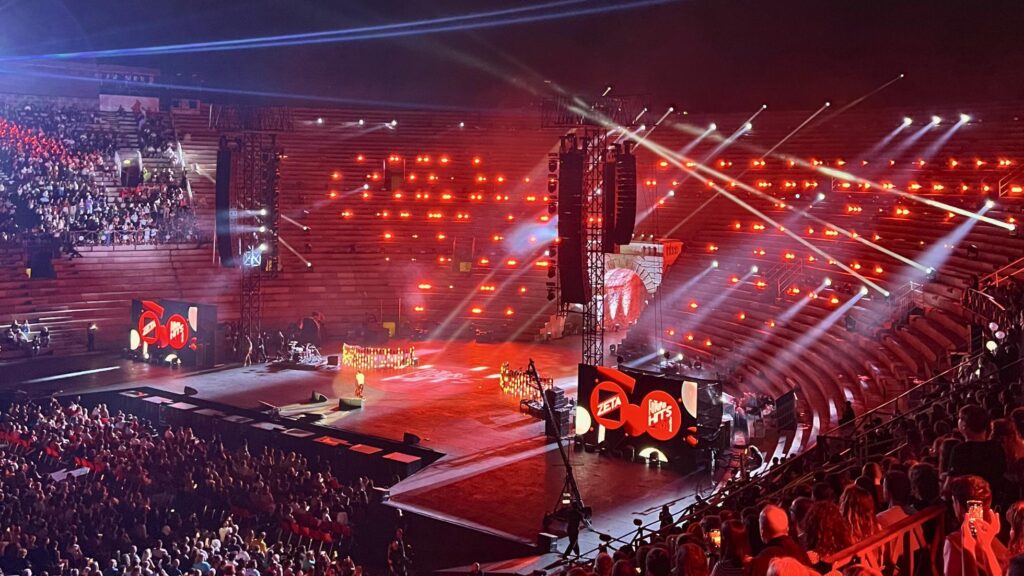
The Colomba d'Oro guide to Live Music in Verona in 2026
The city's two great ancient theaters, the Verona Arena and the Roman Theater, will host in 2026 Italian and international artists, offering a concert program capable of satisfying fans of every musical genre. We are waiting for you!

Roman Age Verona: an archaeological itinerary, just steps from the Colomba d'Oro
Verona still retains a profoundly Roman soul: staying in the four-star hotel in Verona's historic center closest to the Arena is the best way to discover this heritage for a walking itinerary or with a bicycle rented at the hotel.

Hidden Symbols on the palaces of ancient Verona: animals, coats of arms, and mysteries
Beyond the underground ruins lies another Verona—secret, captivating, and hidden in the details that escape the casual traveler. Discover it with Hotel Colomba d’Oro!
