
Hidden Symbols on the palaces of ancient Verona: animals, coats of arms, and mysteries

Verona, a city famous worldwide for being the setting for the love story of Romeo and Juliet, is a place where history unfolds at every turn.
Founded in the 1st century BC by the Romans, the city of the Colomba d’Oro has forged its identity through different eras: from the Romans to the Middle Ages, from the rule of the Dalla Scala to the Venetian and Habsburg domination.
Even at the time of the Roman Empire, Verona was a thriving center due to its strategic location: four important communication routes —the Via Gallica, the Via Claudia Augusta, the Vicum Veronensium, and the Via Postumia—converged and crossed each other right here ; which fostered its economic and cultural growth (Fun fact: this remains the case today, as Verona still enjoys a strategic location, being literally at the crossroads between the East-West highway, connecting Venice to Milan, and the North-South highway, connecting the Brenner Pass—and thus Austria and Germany—with Modena and from there to central Italy.)
If you stay at the Colomba d’Oro, in the very heart of the old city, you’ll have the chance to experience Verona on foot or by bicycle, admiring symbols and hearing ancient stories right from the hotel door with our bike rental service. Here, every façade, arch, and door tells centuries of history, legends, and hidden symbols.
Sleep at the Colomba d’Oro, in the heart of historic Verona
The Colomba d’Oro is located in the midst of all this history, being the closest four-star hotel to the Verona Arena.
Guests of the Colomba d’Oro can explore Verona on foot or by renting a bike at the hotel, losing themselves in its streets and embarking on a true journey through time: architectural wonders, cultural gems, and Roman ruins are scattered throughout the city. Beautiful churches adorned with frescoes and stunning piazzas contribute to Verona’s rich tapestry. Some hidden gems deserve attention, and here are a few tips.
A lesser-known Verona: symbols and hidden details
The center of ancient Verona is rich in monuments, churches, and historic buildings that tell its story; but there is also another Verona, more secret and fascinating. Beyond the underground Verona, there is also a secret Verona on the surface: that of the small details that often “hasty” tourists miss. They are carved symbols, stone animals, heraldic coats of arms, and decorations that require no complex research, just attention and curiosity. They are often found precisely where the eye tends to linger.
The “Mouths of Denunciation” in Piazza dei Signori
A prime example is the “Bocche delle Denunce.” (“Mouths of Denunciation” ). They are located in Piazza dei Signori, behind Piazza Erbe, the square also home to the statue of Dante, a tribute to the great medieval poet who lived in Verona for several years after he was condemned to perpetual exile from his city, Florence. On the façade of the Palazzo della Ragione, you can see two stone faces, carved with gaping mouths. In the Middle Ages, they had a very specific function: they were a sort of “letterbox” that collected citizens’ reports and complaints for the judiciary. They were both a seemingly mysterious decoration and a tool for civic participation.
The Arco della Costa and the Mysterious Bone
Remaining between Piazza delle Erbe and Piazza dei Signori, it’s worth looking up at the Arco della Costa: an elevated passageway connecting the two squares that, in the Venetian era, allowed magistrates to move between the square and the courthouse, avoiding the street and unwelcome encounters.
What made it famous is a large bone, likely a whale’s rib, hanging overhead. There are many interpretations: a rare find, a legendary relic, or the sign of a medieval apothecary. The most fascinating legend, however, is another: it is said that the rib will fall only when a truly honest and pure-hearted person passes under the arch.
Stone Beasts and Where to Find Them
Other curious details are the animals depicted on the facades of the buildings in the City of the Golden Dove. Verona is, in fact, a city rich in “stone animals”:
- mastiffs, linked to the heraldic coat of arms of the Della Scala family, who ruled Verona from the 13th to the 14th century;
- lions, a symbol of courage and strength;
- and then the grotesque figures, the so-called “teste da portón,” heads carved above the doors.
These details reveal a world of popular beliefs, fears, and medieval rituals still visible in the stone today.
Capitoline Wolf on Via Mazzini, a 5-minute walk from the Colomba d’Oro
Walking along Via Mazzini, today the main shopping street in Verona, look up: on the façade of Palazzo Confalonieri da Lisca, at the corner of Via Quattro Spade, stands a “Capitoline Wolf,” a she-wolf sucking the mythical twin founders of Rome, Romulus and Remus. It’s high up and therefore easily overlooked by those who aren’t looking closely. It is the symbol of the city of Rome, and is also found in Verona, recalling the connection with the Roman Empire and, more generally, the idea of continuity with Romanity.
Noble Coats of Arms and Medieval Political Identity
Among the most common symbols in the historic center of Verona are noble coats of arms. In addition to the Della Scala coat of arms, a ladder with four golden rungs on a red field, one can also find the black eagle, a symbol linked to the Ghibelline tradition and the Holy Roman Empire.
The struggle between the Guelphs and Ghibellines was the political and civil conflict that marked Italy between the 12th and 14th centuries, arising from the dispute between the Papacy and the Empire: the Guelphs were the faction that supported the authority of the Pope, while the Ghibellines were the opposing faction that sided with the authority of the Emperor. During the struggles between the Guelphs and Ghibellines, Verona established itself as a Ghibelline center under the rule of the Della Scala family. This political identity is still reflected today in architectural elements such as the “swallowtail battlements,” which are not simply decorations, but true signs of ideological affiliation.
Verona, the city of the Colomba d’Oro, is worth exploring slowly
Every corner of Verona’s historic center invites you to slow down and observe: many details are right before our eyes, yet remain invisible unless we look up. If you stay at the Colomba d’Oro, exploring the city on foot or by bike becomes an immersive experience: a journey through symbols, mysteries, and stories carved in stone. Verona is an open-air museum!
Book at the Colomba d’Oro and discover what Verona has to tell you, through legends, symbols, and stories carved in stone.
FAQ: Visiting Verona from the Colomba d’Oro
Why stay at the Colomba d’Oro to visit historic Verona?
Hotel Colomba d’Oro is located in the heart of Verona’s historic center, just steps from the Arena and Piazza Bra. Its location allows for easy access to squares, historic buildings, and hidden architectural details.
Is the Colomba d’Oro suitable for those who love discovering the less touristy side of Verona?
Yes, the Colomba d’Oro is ideal for those who want to go off the beaten path and discover a Verona full of hidden details, ancient symbols, and stories carved in stone, often overlooked by mass tourism.
Is it possible to visit Verona on foot while staying at the Colomba d’Oro?
Staying at the Colomba d’Oro is the ideal solution for exploring Verona on foot or by bike.
Other Offers
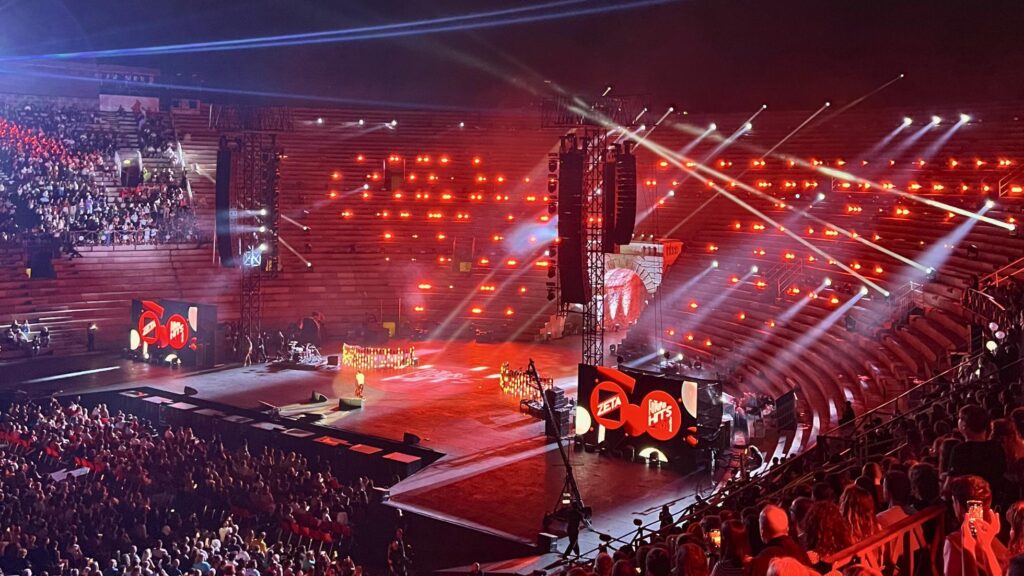
The Colomba d'Oro guide to Live Music in Verona in 2026
The city's two great ancient theaters, the Verona Arena and the Roman Theater, will host in 2026 Italian and international artists, offering a concert program capable of satisfying fans of every musical genre. We are waiting for you!

Roman Age Verona: an archaeological itinerary, just steps from the Colomba d'Oro
Verona still retains a profoundly Roman soul: staying in the four-star hotel in Verona's historic center closest to the Arena is the best way to discover this heritage for a walking itinerary or with a bicycle rented at the hotel.

The Colomba d'Oro guide to Lessinia
Have you ever heard of Lessinia? Hotel Colomba d’Oro tells the story of this ancient plateau in the Venetian Prealps, whose name means 'land prepared and used for grazing.
